
On this day...
...in 1965, the patent for the expendable bathythermograph was granted on December 7 to Walter Graham Campbell, William Van Alan Clark Jr., and Courtland B. Converse, inventors working for the Buzzards Corporation of Marion, Massachusetts. The patent application had been filed on January 31, 1964. The instrument it described was the XBT: a small, dart-shaped probe containing a thermistor, a nose weight, and a spool of fine copper wire, designed to be dropped overboard from a moving ship, fall through the water column at a predictable rate, transmit a continuous temperature signal back to the vessel through the unspooling wire, and then sink to the ocean floor, abandoned. The company that manufactured it, the Buzzards Corporation, later became Sippican Ocean Systems, eventually absorbed into Lockheed Martin. By December 1972, Sippican had manufactured its one-millionth XBT. Today, more than five million have been deployed worldwide.
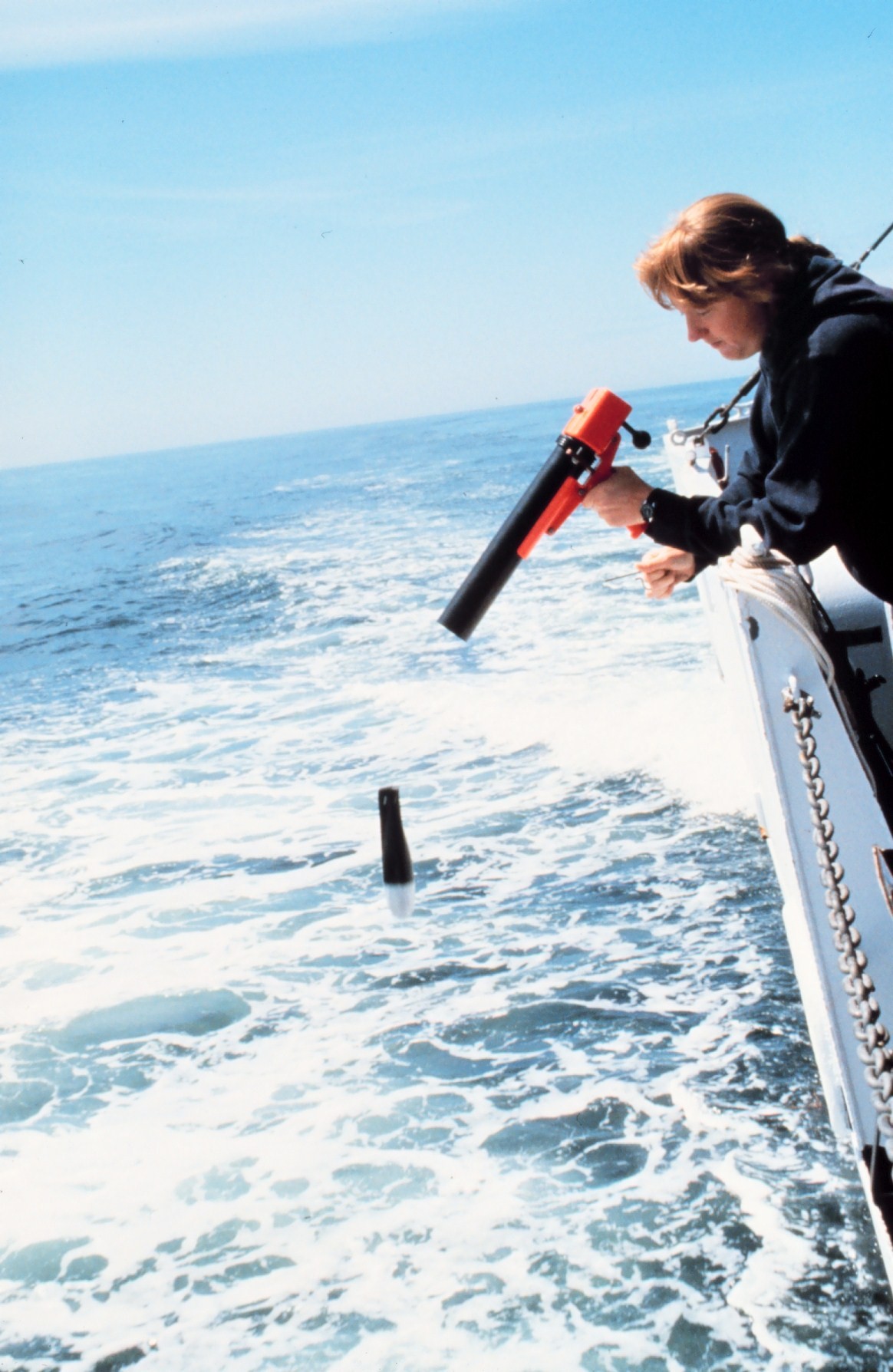
The XBT was not an entirely new idea in 1964: its conceptual predecessor had been sketched out years earlier by James M. Snodgrass at Scripps Institution of Oceanography, who envisioned an expendable probe that would break into two components, one remaining at the surface and one sinking freely. But the patent granted to Campbell, Clark, and Converse represented the practical realisation of that idea in a form that could be manufactured at scale and deployed from a vessel underway without interrupting its operations. The key innovation was the double-spool architecture: one spool of wire inside the probe and a second spool aboard the ship, both paying out simultaneously as the probe fell and the vessel moved forward. Because neither spool dragged against the water, the wire remained effectively stationary relative to the ocean, imposing no friction on the falling probe and allowing it to descend at a constant, predictable rate determined entirely by its weight and geometry. Depth was inferred from elapsed time using a known fall-rate equation rather than measured directly, a simplification that made the instrument cheap enough to be expendable. The US Navy, which had contracted Sippican to develop the XBT and needed a reliable way to map the thermal structure of the ocean for acoustic propagation and submarine detection purposes, evaluated the system in 1965 and adopted it. Within a few years it was being deployed from naval vessels, research ships, and commercial vessels of opportunity worldwide.
The significance of the XBT lay less in its individual measurement than in the density of coverage it made possible. Before the XBT, obtaining a temperature-depth profile required either lowering and recovering a series of Nansen or Niskin bottles with reversing thermometers, which demanded stopping or slowing the ship, or deploying the mechanical bathythermograph, which required the ship to trail a device on a wire and then haul it back aboard. Neither approach was compatible with frequent, repeated profiling along long transects, and neither could be used from non-research vessels. The XBT changed this entirely. Because deployment required only dropping a canister over the side of a moving vessel and monitoring a shipboard recorder for the few minutes the probe was falling, it could be operated by non-specialist crew, from any vessel with deck space, at any speed up to about 30 knots. This opened the global ocean to systematic upper-ocean temperature profiling at a scale that dedicated research cruises could never have achieved alone.
The results were transformative. From the late 1960s onwards, XBT deployments from naval vessels, merchant ships, ferries, and cargo carriers began filling in the vast observational gaps in the global ocean temperature record. The Ships of Opportunity Programme, formalised as part of the Global Ocean Observing System in the 1990s, coordinated the deployment of XBTs from commercial vessels along high-traffic shipping lanes, producing repeated transects of upper-ocean temperature across the Atlantic, Pacific, and Indian basins on timescales and at spatial resolutions that no other platform could match at reasonable cost. By 1990, a global XBT data distribution system was in place, feeding near-real-time temperature profiles into operational weather and ocean forecasting models. During the World Ocean Circulation Experiment, XBTs deployed from vessels of opportunity along repeat transects provided the high-resolution, basin-scale upper-ocean thermal sections that satellite altimetry and the sparser hydrographic survey could not supply on their own. Dean Roemmich and Bruce Cornuelle at Scripps Institution of Oceanography developed the High Resolution XBT Network in the late 1980s, proposing the use of automated XBT launchers along fixed shipping routes to WOCE planners, and in 1990 the NSF incorporated the HR-XBT Network into the WOCE observing plan. That network continued operating for decades and contributed to the discovery of long-term trends in ocean heat content.
The XBT record is not without complications. A time-varying warm bias in the global XBT archive has been identified as a significant source of uncertainty in estimates of historical ocean heat content change, caused by small, gradual changes in the fall rate of probes associated with manufacturing variations at Sippican's factory over the decades. Correcting for these biases has required detailed analysis of the production history of different probe types and comparison with contemporaneous CTD and Argo measurements, a painstaking effort whose results have substantially revised earlier estimates of ocean warming rates. The fall-rate problem does not diminish the XBT's contribution to oceanography: it illustrates, rather, the degree to which the instrument's archive has become foundational enough that its systematic errors are worth the effort of understanding and correcting.
The contributions of the XBT to physical oceanography can be grouped across several interconnected dimensions:
- Global upper-ocean temperature coverage: By enabling deployment from vessels of opportunity at sea speed and without specialist crew, the XBT made systematic, repeated profiling of the upper ocean along major shipping lanes possible at global scale, producing the densest long-term record of upper-ocean thermal structure available before the Argo era.
- Naval and military oceanography: The XBT was developed at the explicit request of the US Navy to map the thermal structure of the ocean for acoustic propagation modelling and submarine detection, and its adoption by naval vessels worldwide created one of the earliest sustained global ocean observing efforts.
- Ships of Opportunity Programme: The XBT's ease of deployment from non-research vessels formed the operational foundation of the Ships of Opportunity Programme, which integrated commercial shipping into the global ocean observing system and continues to contribute upper-ocean temperature and salinity data to this day.
- WOCE High Resolution XBT Network: During the World Ocean Circulation Experiment, repeat XBT transects along fixed shipping routes provided the basin-scale upper-ocean thermal sections that underpinned the validation of ocean circulation models, extending the spatial coverage of the WOCE observing system into regions and at resolutions inaccessible to dedicated research cruises.
- Ocean heat content monitoring: The multi-decadal global XBT archive, despite the fall-rate bias issues that have required careful reprocessing, constitutes one of the primary datasets for reconstructing the history of upper-ocean heat content change since the 1960s, and its correction has driven significant advances in understanding both the instruments themselves and the long-term warming of the ocean.
The patent granted on December 7, 1965 described a probe that would be used once and discarded, a device cheap enough to be treated as consumable. That disposability was precisely the point: the XBT was designed not for the laboratory but for the ocean at scale, for the merchant captain who could drop one over the side without slowing down and the naval officer who needed a thermal profile before the next watch. In making temperature profiling cheap enough to be routine, it quietly transformed what oceanographers could know about the upper ocean, and laid the observational groundwork for everything that has followed.
Sources
- US Patent 3,221,556. Campbell, W.G., Clark, W.V.A. Jr., and Converse, C.B. (1965). Bathythermograph System. Buzzards Corporation, Marion, Massachusetts. Filed January 31, 1964. Granted December 7, 1965.
- Abraham, J.P. et al. (2013). A review of global ocean temperature observations: Implications for ocean heat content estimates and climate change. Reviews of Geophysics, 51, 450–483.
- Around the Pier: Thirty Years On, a Groundbreaking "Gem" Still Shines - Scripps Institution of Oceanography
- Bathythermograph - Wikipedia
- Reprocessing of XBT profiles from the Ligurian and Tyrrhenian seas - Earth System Science Data