
On this day...
...in 1989, the first issue of Oceanography magazine published in April carried a four-page article by Henry Stommel titled "The Slocum Mission." Written in the first person, set in the year 2021, and narrated by a fictional scientist reflecting on twenty-five years of operating a global fleet of autonomous underwater vehicles from a control centre on Nonamesset Island near Woods Hole, it was not a scientific paper in any conventional sense. It was a vision, written in the style of science fiction, describing a world in which a thousand small, wingless gliders called Slocums criss-crossed the ocean continuously, drawing their propulsive energy from the temperature difference between warm surface waters and the cold deep, and sending back a continuous stream of ocean observations that had transformed the science of physical oceanography. Stommel, one of the most influential physical oceanographers of the twentieth century, wrote it not to report results but to inspire a generation of engineers and scientists to build what he was imagining.
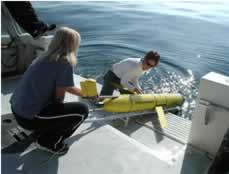
The idea had not emerged from nowhere. Stommel had been discussing the concept of a thermally-powered ocean glider with his neighbour and collaborator Douglas Webb since the mid-1950s. Webb, an engineer at WHOI, had been working for years on the practical problem of building a vehicle that could extract propulsive energy from the ocean's thermal stratification: when a glider descends into colder water, a phase-change material contracts and draws in hydraulic fluid, changing the vehicle's buoyancy; when it rises into warmer water the process reverses. Combined with fixed wings, the alternating ascent and descent produces forward motion without any battery-powered thruster. The concept was elegant and the energy source inexhaustible, but the engineering challenges were formidable. Stommel's article gave the idea a name, a narrative, and a community of readers who would spend the next decade turning it into hardware.
The first Slocum glider prototypes were tested in the late 1990s at Webb Research Corporation, the company Doug Webb had founded after leaving WHOI. The first sustained operational deployments began in the early 2000s. By the time the fictional 2021 of Stommel's story arrived, the global glider fleet he had imagined had not reached a thousand vehicles, but hundreds of Slocum, Spray, and Seaglider instruments were being deployed annually by research institutions, navies, and environmental monitoring agencies worldwide, sampling the ocean's interior in ways that no ship-based programme could replicate at comparable cost. The article published in April 1989 had been, in the most literal sense, a self-fulfilling prophecy.
Sources