On this day in history...
...in 2004, the manuscript that would become one of the most cited papers in the history of physical oceanography was accepted for publication on August 16. Its authors were Alexander F. Shchepetkin and James C. McWilliams, both at the Institute of Geophysics and Planetary Physics at the University of California, Los Angeles. The paper, titled "The Regional Oceanic Modeling System (ROMS): a split-explicit, free-surface, topography-following-coordinate oceanic model," appeared in Ocean Modelling in 2005 and has accumulated more than 4,800 citations in the two decades since, a figure that places it among the most influential technical contributions in the literature of ocean science. It is the foundational reference for one of the most widely used ocean circulation models in the world.
To understand what Shchepetkin and McWilliams achieved, it helps to understand the problem they were solving. By the late 1990s, numerical ocean modelling had advanced to the point where realistic simulations of regional ocean circulation were within reach, but existing models were struggling with two sets of difficulties that undermined their accuracy in precisely the coastal and shelf environments where the physics are most complex and the practical stakes are highest. The first difficulty was numerical: the time-stepping algorithms used in most models to split the fast (barotropic) and slow (baroclinic) modes of ocean circulation were introducing errors that accumulated over long integrations and degraded the accuracy of the solutions. The second was geometric: representing the sloping topography of continental shelves and slopes accurately required a vertical coordinate system that followed the ocean bottom, but existing terrain-following coordinate implementations generated spurious pressure gradient errors in regions of steep bathymetry that could produce fictitious currents with magnitudes comparable to real circulation features. Both problems had been known for years. What Shchepetkin and McWilliams did was solve them simultaneously, through a combination of mathematical rigor and algorithmic innovation that resulted in a model whose numerical behaviour was qualitatively better than what had been available before.
The paper's central contribution was a new family of time-stepping algorithms that combined forward-backward feedback with the best properties of classical synchronous schemes, allowing an increased time step without sacrificing accuracy or stability. The key insight was that after computing a time step for the momentum equation, the resulting velocities should participate immediately in the computation of tracers and continuity, rather than being held constant for the duration of the step. This seemingly small change in the ordering of operations eliminated a class of numerical instabilities that had constrained previous mode-splitting approaches, and it did so while maintaining the conservation properties that physically meaningful ocean simulations require. Combined with a careful treatment of the pressure gradient formulation that reduced the spurious velocities generated by sigma-coordinate models over steep topography, the result was a model that could be run at high resolution in regions of complex bathymetry without the numerical artefacts that had made such applications unreliable.
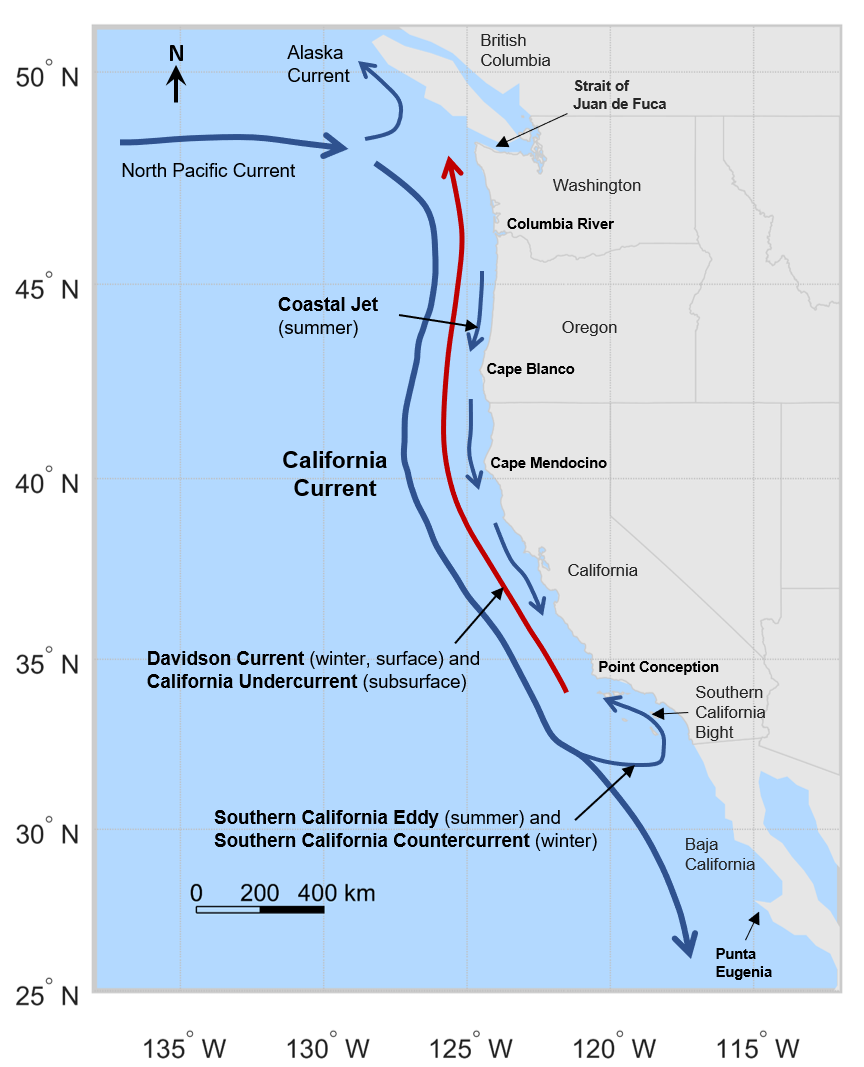
The immediate scientific context for ROMS was the study of eastern boundary upwelling systems, and the California Current in particular. Coastal upwelling systems, where wind-driven Ekman transport pulls cold, nutrient-rich water from depth to the surface, are among the most productive marine environments on Earth, accounting for less than one percent of the global ocean area but roughly twenty percent of the global fish catch. They are also among the most dynamically complex: their circulation is shaped by interactions between wind forcing, mesoscale eddies, submesoscale fronts, topographic steering, and the exchange between the continental shelf and the open ocean, all at spatial scales that global ocean models cannot resolve. ROMS was designed from the outset to handle this complexity, and the California Current System became both the primary test bed for its development and one of its most intensively studied applications. Within a few years of the 2005 paper's publication, ROMS-based simulations of the California Current were producing results that matched observations with a fidelity that had not previously been achievable, capturing the seasonal upwelling cycle, the generation of mesoscale eddies and filaments, the cross-shelf transport of nutrients, and the coupled physical-biogeochemical dynamics of one of the world's most studied ocean regions.
From those origins, ROMS expanded to become a global standard for regional ocean modelling. The model has been applied to every major ocean basin and every class of regional circulation problem: the Humboldt and Benguela upwelling systems, the Gulf Stream and its extensions, the South Atlantic and its boundary currents, the Mediterranean and its marginal seas, the Arctic and its ice-covered shelves, the coral reef systems of the tropical Pacific, the estuaries and coastal zones of every inhabited continent. It has been coupled to atmospheric models, sea ice models, biogeochemical models, sediment transport models, and wave models. It has been used to study climate variability, ocean acidification, coastal flooding, fisheries dynamics, the dispersal of pollutants, and the planning of marine protected areas. The ROMS user community, centred on the myroms.org platform, encompasses hundreds of research groups in dozens of countries and has produced thousands of publications across physical oceanography, biological oceanography, marine biogeochemistry, and coastal engineering.
The contributions of Shchepetkin and McWilliams (2005) to ocean science can be grouped around several interconnected dimensions:
- Solution of the mode-splitting problem in ocean models: The new family of time-stepping algorithms introduced in the paper eliminated the numerical instabilities associated with the barotropic-baroclinic decomposition that had constrained previous free-surface ocean models, enabling longer time steps, more accurate solutions, and more reliable long integrations in complex regional domains.
- Accurate terrain-following coordinates over steep topography: The paper's treatment of the pressure gradient formulation in sigma-coordinate ocean models substantially reduced the spurious velocities generated over steep bathymetry, making high-resolution simulations of continental shelves, slopes, and seamounts numerically reliable for the first time.
- Foundation of high-resolution coastal and regional ocean modelling: By combining these numerical advances in a single, well-documented, and openly distributed modelling system, Shchepetkin and McWilliams created the technical infrastructure that has underpinned two decades of progress in the simulation of coastal, shelf, and regional ocean circulation worldwide.
- Platform for coupled physical-biogeochemical ocean science: The accuracy and flexibility of ROMS made it the model of choice for a generation of coupled physical-biogeochemical simulations, from eastern boundary upwelling systems to coral reef ecosystems, enabling the study of ocean acidification, deoxygenation, nutrient cycling, and marine productivity at resolutions and in regions inaccessible to global models.
- Community standard for regional ocean prediction: The ROMS framework, built on the algorithmic foundations of the 2005 paper, has been adopted by operational forecasting centres, climate research programmes, and coastal management agencies worldwide, making it one of the primary tools through which ocean science informs the management of coastal resources and the prediction of marine environmental change.
The Shchepetkin and McWilliams paper belongs to a specific category of scientific contribution: the technical paper that does not discover a new phenomenon or propose a new theory, but instead removes an obstacle that had been limiting what the rest of the community could do. Its citation count reflects not the fame of the physical processes it describes but the breadth of the community that depends on the model it built. Every study of upwelling dynamics, coastal hypoxia, mesoscale eddy-shelf interaction, or regional sea level change that uses ROMS traces its numerical foundation back to the algorithms developed in the paper accepted on August 16, 2004.
Sources
- Shchepetkin, A.F. y McWilliams, J.C. (2005). The Regional Oceanic Modeling System (ROMS): a split-explicit, free-surface, topography-following-coordinate oceanic model. Ocean Modelling, 9, 347–404.
- ROMS User Community - myroms.org
- Regional Ocean Modeling System - Wikipedia
- The Regional Oceanic Modeling System (ROMS) - ResearchGate